
Grenfell Anniversary: Why Inclusive Evacuation Planning Must Include “Everyone Safely Out”
On 14 June, the UK remembers the Grenfell Tower fire and the 72 people who tragically lost their lives. It remains one of the most devastating residential fire tragedies in modern British history and continues to shape conversations around building safety, fire responsibility and emergency evacuation planning.
However, while this anniversary is an important moment of remembrance, it also serves as a reminder that emergency planning must work for everyone. Building owners, facilities managers, housing providers and responsible persons must create inclusive emergency evacuation plans for residents, staff, visitors and vulnerable people who cannot evacuate independently.
The shift towards inclusive evacuation planning
Since Grenfell, there has been much needed and increased scrutiny on how buildings are prepared for emergencies, particularly when lifts cannot be used and people need support to leave safely.
Creating better evacuation plans for disabled, elderly and mobility-impaired people is one of the most important areas to focus on for inclusivity and safety. The Grenfell Tower Inquiry made recommendations relating to Personal Emergency Evacuation Plans, commonly known as PEEPs, for residents who cannot safely evacuate by themselves. The UK Government has since introduced Residential PEEPs regulations in England, which came into force on 6 April 2026 and apply to certain high-rise and medium-rise residential buildings. These regulations are designed to improve fire safety and evacuation planning for residents who would have difficulty evacuating on their own.
These newly introduced regulations are a welcome safeguarding measure, requiring emergency evacuation planning to consider the specific needs of every person inside a building.
What are PEEPs and why do they matter?
A Personal Emergency Evacuation Plan (PEEP) is designed to identify how someone who may struggle to evacuate independently can be supported during an emergency.
In residential settings, the government’s Residential PEEPs process includes identifying relevant residents, carrying out personalised fire risk assessments where requested, creating emergency evacuation statements where agreed. This information is then shared with the Fire and Rescue Authority, where consent is given, and reviewed over time.
This personalised approach is particularly important as every building is different, and every person’s needs are unique. Plans must consider that some people may have reduced mobility, while others may have a visual or hearing impairment, cognitive condition, temporary injury, pregnancy-related mobility issues, or other needs that affect their ability to evacuate quickly and safely.
A comprehensive evacuation plan should answer practical questions such as:
- Who may need assistance during an evacuation?
- What support will they need?
- What equipment is available?
- Who is trained to use it?
- Is the equipment maintained and ready?
- Has the plan been reviewed recently?
- Is the Fire and Rescue Authority given relevant information where appropriate?
Without clear answers to these questions, evacuation planning can leave dangerous gaps.
Increased scrutiny on means of escape
The Grenfell tragedy brought renewed attention to the way buildings are designed, managed and prepared for emergencies. Since Grenfell, regulations have significantly changed and the Building Safety Act 2022 introduced greater accountability for owners and managers of higher-risk buildings. This includes requirements around safety case reporting, resident engagement and ongoing risk management.
The Government’s response to the Grenfell Tower Inquiry Phase 2 report also highlighted fire safety improvements introduced since 2017, including new legal requirements, improved information sharing and communication with residents and emergency services, regular checks on fire doors, and increased fines for offenders.
For responsible persons, this means the expectations are higher, and having a written fire policy sitting in a folder is no longer adequate. All fire safety arrangements need to be practical, up to date and evidence-based.
Means of escape should be assessed through the eyes of real users. For example, while an emergency staircase is suitable for some people, wheelchair users or people with limited mobility cannot safely descend unaided. In those situations, assisted evacuation planning becomes life-saving.
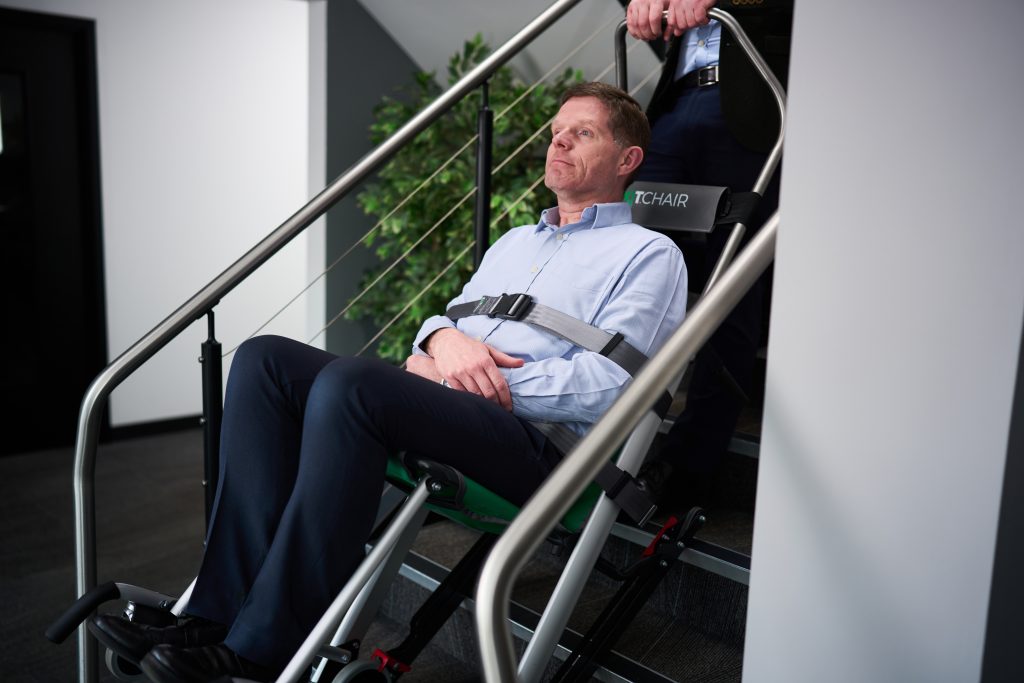
Evacuation chairs and assisted evacuation equipment is essential in helping people move safely down stairs when lifts cannot be used.
However, having access to evacuation equipment alone is not enough. A chair that has not been maintained, is difficult to access, or its operation is only understood by one member of staff creates risk. The right approach combines:
- suitable evacuation equipment
- clear procedures
- trained operators
- regular servicing
- accessible storage
- visible signage
- periodic reviews
- alignment with the building’s wider fire strategy
Having a practical evacuation plan allows staff to confidently respond to emergencies. This goes beyond a paper-based evacuation plan and prepares staff to be ready in case of an emergency.
The role of assisted evacuation equipment
Training is central to safer evacuation
Evacuation chair training gives operators the confidence to act quickly, calmly and safely. It also helps organisations understand how their evacuation procedures work in practice, not just in theory.
Training should cover how to prepare the chair, how to safely transfer a passenger, how to control movement on stairs, how to communicate with the passenger, and how to reduce risk for both the operator and the person being evacuated.
For many buildings, training also helps identify practical issues that may not be obvious from a written risk assessment. These could include unsuitable storage locations, narrow corridors, unclear responsibilities, poor signage, or a lack of trained staff across different shifts.
Responsible evacuation planning should also include evidence that equipment is safe and ready to use.
An evacuation chair may sit unused for long periods, but it still needs to be inspected and maintained. Annual evacuation chair servicing helps ensure that key components are checked, faults are identified, and the equipment remains reliable in an emergency.
For organisations with compliance responsibilities, servicing records also provide evidence that reasonable steps have been taken to maintain life-safety equipment.
Servicing and maintenance provide evidence of readiness
A more inclusive approach to fire safety
The legacy of Grenfell has changed the way many organisations think about fire safety. The focus shifted towards inclusive, person-centred and evidence based evacuation planning.
For residential buildings, workplaces, public buildings, healthcare settings, schools, hotels and commercial properties, the principle is the same: evacuation plans should reflect the real people who use the building.
That includes people with long term disabilities, temporary injuries, age-related mobility issues, sensory impairments, cognitive conditions, or any other factor that may affect their ability to leave safely in an emergency.
How Exitmaster can support safer evacuation planning
Exitmaster manufactures British-made evacuation chairs designed to support safer assisted evacuation when lifts cannot be used. Supported by 28 years of experience, Exitmaster provides evacuation chairs, accessories, training and servicing options to help organisations improve emergency preparedness.
Our range includes models designed for different building needs, including premium evacuation chairs with enhanced passenger comfort and safety, upright four wheel options, budget friendly models, traditional kickstand style chairs, storage solutions, covers, signs and accessories.
Whether you are reviewing your evacuation procedures, planning for PEEPs, improving accessibility, or checking that existing evacuation chairs are ready for use, Exitmaster can help you put practical measures in place.
Be prepared before an emergency happens
The anniversary of Grenfell is a time to remember, reflect and act responsibly. Inclusive evacuation planning must be about making sure every person has a safer way out when an emergency happens.
If your building has residents, staff or visitors who may need support during an evacuation, now is the time to review your arrangements to ensure that your equipment remains compliant, is regularly maintained and always ready-to use.
Speak to Exitmaster today about evacuation chairs, training and servicing options.