
Exitmaster evacuation chairs provide a safe, controlled and dignified way to assist people with reduced mobility down stairs when lifts cannot be used. Designed for offices, hospitals, schools, public buildings and other multi-storey premises, our British-made range supports inclusive emergency evacuation planning.
Choose from upright and traditional designs to suit different staircases, landing spaces, passengers and operator requirements. Whether you refer to the equipment as an evac chair, stair evacuation chair, stairway evacuation chair or emergency evacuation chair, Exitmaster can help you identify the right model for your building and evacuation strategy.
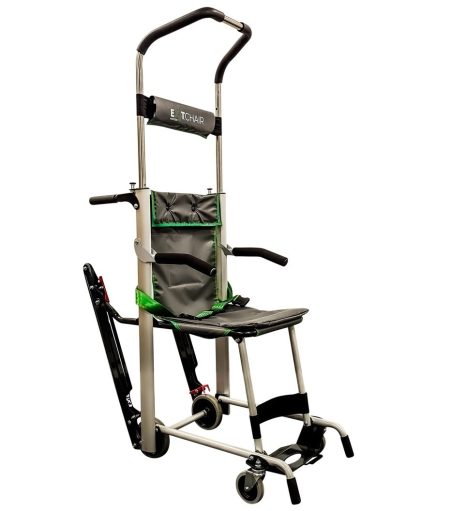
An evacuation chair is a specially designed device that allows a person with limited mobility to be safely transported down stairs during an emergency, such as a fire or lift failure.
Evacuation chairs use stair-contact tracks, wheels or a combination of both to help an operator control the passenger’s movement. They are assisted evacuation devices and should be used by people who have received suitable training and understand the building’s evacuation procedure.
Exitmaster evacuation chairs are designed to support:
Exitmaster offers five principal chair models, ranging from a traditional kickstand-style design to advanced upright four-wheel chairs. Use the comparison below to identify the most relevant options before reviewing the full product specifications.
| Model | Chair design | Key features and suitability | Landing space |
| Original evacuation chair | Traditional kickstand-style chair | A familiar assisted stair-descent format with a Free-walk design for operator comfort. Suitable for organisations seeking a straightforward traditional evacuation chair. | 100cm × 100cm |
| Ego evacuation chair | Upright four-wheel chair | A budget-conscious upright model with one-operator loading and travel, a Free-walk design and a passenger footrest. Its smaller stated landing requirement may suit more restricted spaces. | 75cm × 75cm |
| Versa evacuation chair | Upright four-wheel chair | The flagship Versa model, featuring Stoop-free and Free-walk operator ergonomics, a large passenger footrest and a top-step safety feature. | 80cm × 80cm |
| Versa Plus evacuation chair | Upright four-wheel chair with mobility handles | Includes the core Versa features with additional handles to support easier movement along corridors and across level surfaces. | 90cm × 90cm |
| Versa Elite evacuation chair | Premium upright four-wheel chair | Adds mobility handles, armrests and a four-point harness for organisations prioritising enhanced passenger support, comfort and safety. | 90cm × 90cm |
All five current models state a maximum passenger capacity of 180kg. Capacity is only one part of model selection, so the passenger’s support requirements, transfer method, staircase, landings and operator availability must also be considered.
Compare features, building needs and compliance requirements with expert support from Exitmaster.
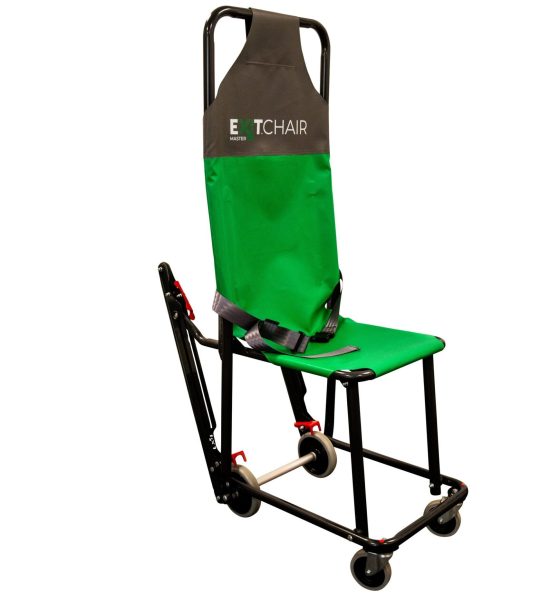
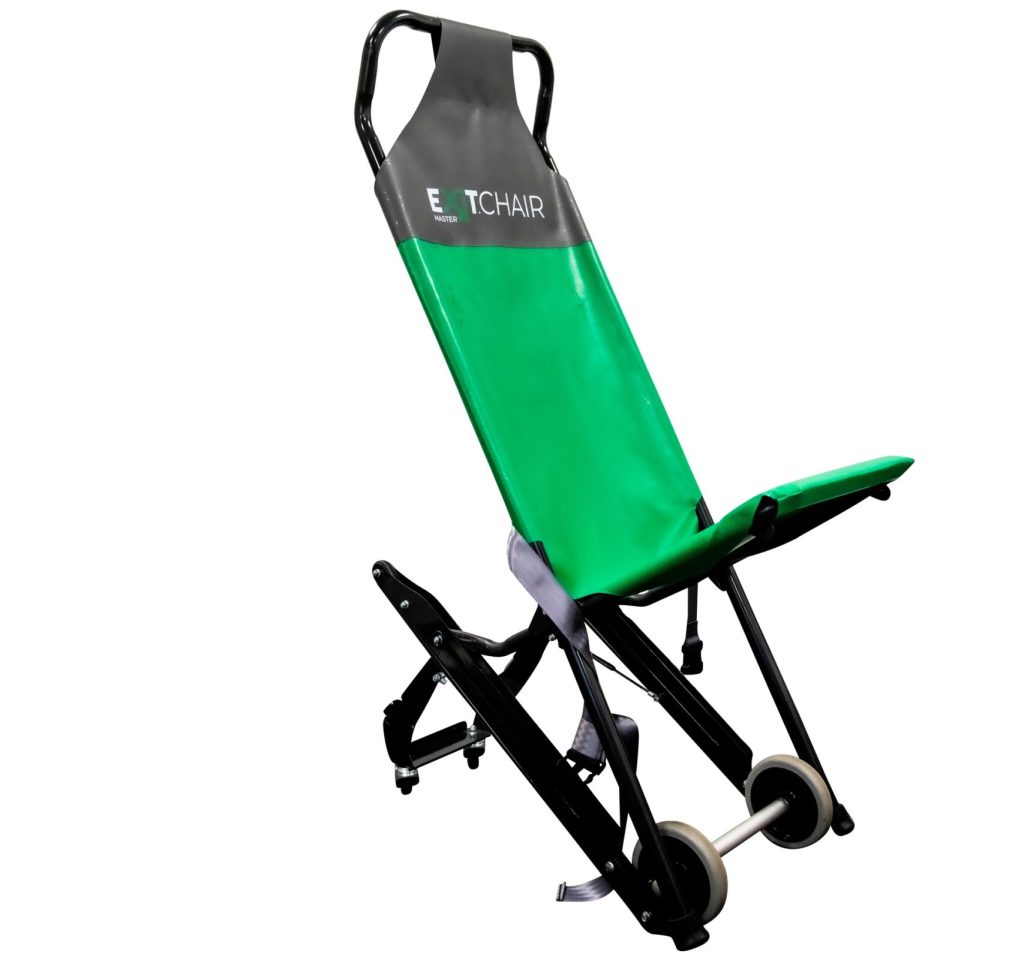
There is no single fixed number of evacuation chairs that applies to every building. The appropriate quantity and location should be determined through the fire risk assessment, evacuation strategy and any relevant Personal Emergency Evacuation Plans.
Your assessment should consider:
Use the evacuation chair risk assessment guide to review the practical considerations and consult the guide to UK evacuation chair regulations for further planning and compliance context.
An evacuation chair should be protected, clearly identified and readily accessible to trained staff. The storage position must support the agreed evacuation procedure without obstructing the staircase, corridor or escape route.
Available storage and readiness accessories include:
Storage arrangements should be reviewed if the building layout, staffing, evacuation route or expected passenger needs change.
Suitable evacuation chair training helps designated operators understand deployment, passenger preparation, restraints, controlled stair descent and safe handling. It also gives staff an opportunity to practise before the equipment is required during an emergency. Training requirements should account for shift patterns, staff turnover and the number of people expected to operate each chair. Refresher sessions may be appropriate where skills have not been practised regularly.
Regular evacuation chair servicing helps identify wear, damage, missing components or operational issues. Exitmaster provides maintenance and inspection support through certified engineers, with servicing-contract options available for selected chair models. Internal checks should also confirm that the chair remains in its designated position, has not been obstructed or damaged and still has the necessary instructions, signs and restraints.
When comparing an evacuation chair with warranty protection, confirm the warranty length, scope and conditions for the selected model and purchasing package. Exitmaster chairs are available with warranty protection alongside optional training and servicing support. A warranty does not replace routine inspection, correct storage, operator training or scheduled servicing. These elements work together to keep the chair ready for use and protect the organisation’s longer-term investment.
Backed by 25 years of experience, Exitmaster designs and manufactures evacuation chairs in Britain with close attention to passenger safety, dignity and operator control.
Evacuation chairs can support fire safety, accessibility and inclusive evacuation responsibilities when they are selected and managed as part of a suitable wider strategy. They may be considered within fire risk assessments and Personal Emergency Evacuation Plans for people who cannot use stairs independently.
Readiness depends on more than having a chair in the building. Equipment should be suitably positioned, kept accessible, regularly checked and supported by trained operators who understand the agreed procedure.
Requirements differ between premises, so organisations should base purchasing decisions on a competent assessment rather than assuming that one chair model, quantity or storage position will suit every environment.
Useful information includes the building type, staircase and landing dimensions, evacuation route, expected passenger needs, number of available operators and whether the chair must travel across level floors before or after the stairs.
On-site training can help operators practise with the equipment in the building where it may be used. This allows the session to reflect local staircases, storage points and evacuation procedures.
Yes. Exitmaster can help multi-site organisations compare chair requirements and coordinate product provision, accessories, operator training and servicing across different premises.
The chair should be checked for damage, wear, contamination or missing parts before being returned to its storage position. An inspection or service should be arranged if there is any concern about its condition or operation.
A Stoop-free evacuation chair is designed to reduce the need for the operator to bend during operation. This feature is available on the Versa, Versa Plus and Versa Elite. Free-walk evacuation chair design supports a more natural operator position and controlled movement, and is incorporated into the Versa family, Ego and Original models.
The term heavy duty evacuation chair is sometimes used when searching for a higher-capacity model. All five current Exitmaster chairs state a maximum passenger capacity of 180kg, but suitability must also consider body shape, posture, transfer requirements, restraints, staircase configuration and operator availability.
Useful information includes the stair angle, landing dimensions, turns within the route, corridor travel and the distance between the storage point and staircase. Exitmaster should also be told about any particularly restricted spaces or passenger-transfer requirements.
Compare the Original, Ego, Versa, Versa Plus and Versa Elite to identify the most appropriate emergency evacuation chair for your building. Exitmaster can also help you plan storage, accessories, operator training, servicing and longer-term support.